 Memory Notch
LOCAL TRANSCRIPTION. YOUR CHOICE OF AI.
Record offline.
Think further.
A local transcription tool for Mac, with notes you can use in ChatGPT, Claude, and Cursor. Capture the conversation with Memory Notch. Choose what your AI gets to read.
Start with Claude Code, or follow the Cowork, ChatGPT Desktop, Codex, and Cursor guides below. No special Memory Notch connector or MCP server: use a selected folder, or attach a transcript in ordinary chat. Nothing syncs automatically.
Memory Notch records and transcribes on your Mac. Letting another AI read those files can send their contents to that provider for processing. Check your account’s data settings and workplace policies first. The AI app’s subscription, permissions, and data handling are separate from your Memory Notch licence.
01 / START WITH THE RIGHT FILES
One recording is enough to start.
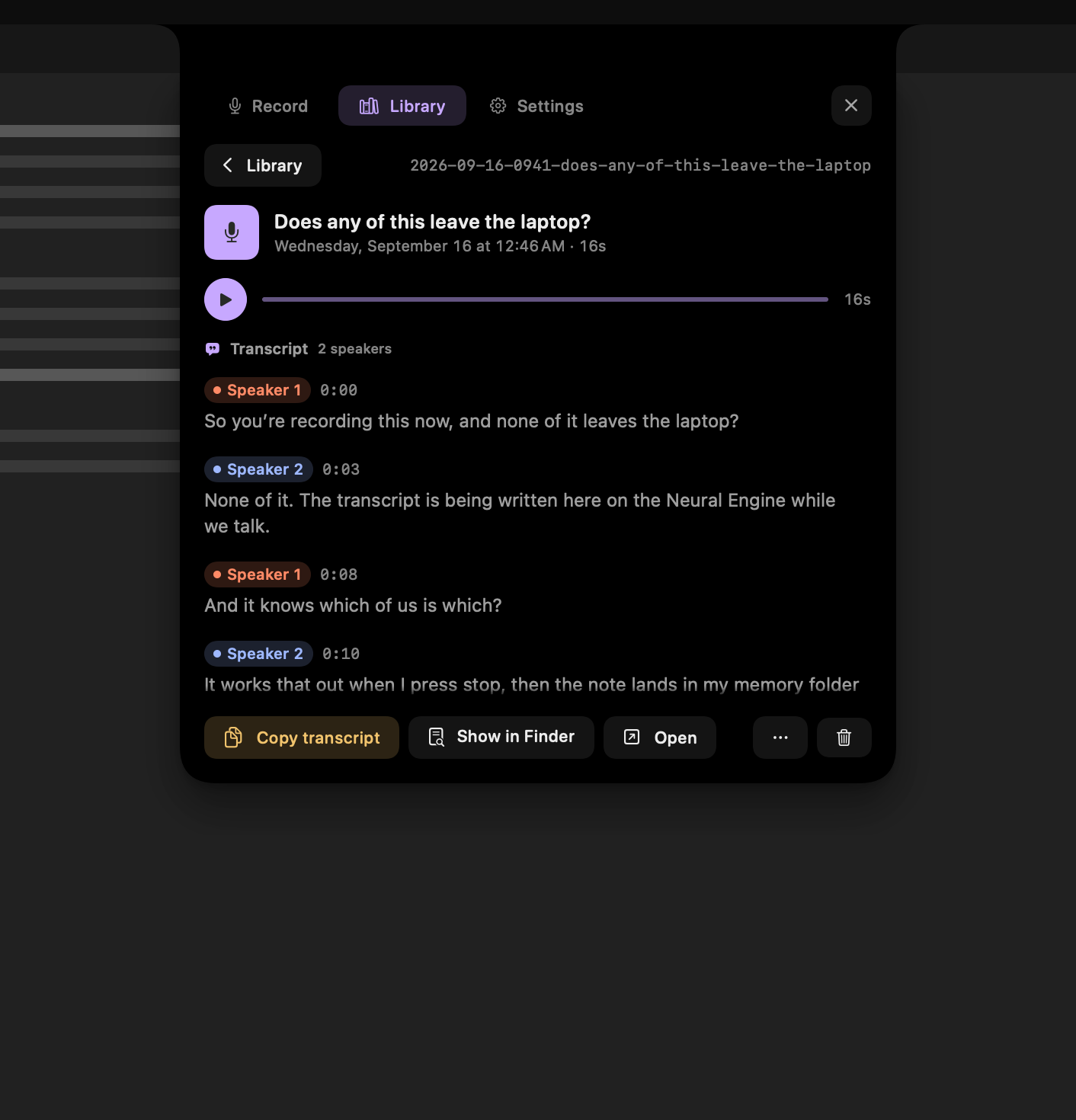
- In Memory Notch, open Library, choose a recording, and select Show in Finder. Or, in Finder, press ⇧⌘G and enter
~/memory/notes. - Select that recording’s folder. Its
.mdfile holds metadata and paths; the matching.txtfile contains the transcript. Give the AI both, not just the Markdown file. - For a narrower text-only scope, copy the selected
.mdand.txtfiles into a separate folder such as~/Documents/Memory Notch AI. Keep filenames together. Tell the AI to use the co-located transcript if a copied note’s original path cannot be reached.
Leave audio and video out unless your task needs them. Copied files are a snapshot: new recordings are not added automatically.
02 / RECOMMENDED CLAUDE ROUTE · CODE TAB · LOCAL
Claude Code
Our first choice for this folder-based workflow: use Claude Code inside Claude Desktop to read selected notes directly. You do not need to write code to ask questions about text files.
Select Code, then Local
Open Claude Desktop and select the Code tab. In the prompt area, choose Local as the environment—not Cloud or SSH.
Choose your notes as the project folder
Use the project-folder picker to select one recording folder or your separate AI-review folder. Keep the .md and .txt files together. You are choosing a working folder, not connecting a Memory Notch account.
Start with a read-only request
Choose Manual permission mode (Ask permissions in older versions), then use the verification prompt below. You can @-mention specific files in local sessions. Review requests to edit files or run commands; do not enable Bypass permissions for this task.
Local selects where the tools run and files live. It does not make Claude’s model run offline on your Mac.
Checked September 16, 2026 · Anthropic’s Claude Code Desktop guide ↗
recording-id/Note title, metadata, and file paths
The words that were spoken
Code → Local → project folder → verify
03 / COWORK · SELECTED LOCAL FOLDER
Claude Cowork
Use Cowork in the desktop app for direct access to a chosen folder. Ordinary Claude chat does not automatically read a path you type.
Open Cowork
Open Claude Desktop, sign in, and select Cowork in the message box. This requires an eligible paid Claude plan and an internet connection.
Connect the folder you chose
Ask to work with your selected recording folder and use the local-folder selection or access prompt. Review the exact folder before approving. Keep Claude Desktop open while Claude needs the local files.
Check access, then ask your question
Use the verification prompt below. Confirm Claude can read both the Markdown note and its transcript before asking for a recap. Keep approval prompts enabled and review any proposed edits.
Local access is not offline AI: Anthropic describes Cowork processing in its cloud. Availability and controls depend on your plan and app version.
Checked September 16, 2026 · Anthropic’s Cowork setup guide ↗
recording-id/Note title, metadata, and file paths
The words that were spoken
Cowork → selected folder → verify files
04 / CHAT VERSUS WORK · NOT THE SAME AS CODEX
ChatGPT Desktop
Chat is for conversation with the context you provide. ChatGPT Work can carry out file-based tasks. Codex is a separate agent workflow in the desktop app, covered below.
For a one-off question: Chat
Attach the selected transcript using the composer’s file control, or paste its text. This shares a snapshot, not ongoing access to the folder. Typing ~/memory does not give ordinary Chat access to that path.
For local folders: Work
Where available, choose Work in the desktop app and use a local project attached to your selected notes folder. Confirm the session is working with files on this Mac. Web-only projects and cloud file storage are different.
Check which mode you are using
Verify the files before asking for analysis. If local Work is unavailable on your account or platform, use the Codex local-project steps instead, or stay with explicitly attached files. Do not assume every ChatGPT desktop mode has identical file access.
ChatGPT Desktop is the app; Chat, Work, and Codex are different workflows. Local file access does not mean offline AI processing.
Checked September 16, 2026 · OpenAI’s desktop workflow guide ↗ · Local projects and attached files ↗
recording-id/Note title, metadata, and file paths
The words that were spoken
Chat: file snapshot · Work: local project
05 / DESKTOP · LOCAL PROJECT
Codex
Give a local project access to your selected note folder. A cloud project or an uploaded Markdown file is not the same as access to your Mac’s recording folder.
Choose a local project
In the desktop app, create or select a local project for these notes. Current OpenAI documentation groups Codex within the ChatGPT desktop app; labels can differ in older Codex builds.
Attach the selected folder
Open the project menu, choose Edit project, then Add folder. Select the recording folder or your separate AI-review folder. Make it the primary folder if this project is only for notes. Do not attach unrelated folders.
Start a Codex chat in that project
Use a local session that works with the selected folder, then send the verification prompt below. Keep sandbox and approval protections enabled; you do not need unrestricted access, a Git repository, or an MCP server for this workflow.
The project organizes file access; permissions and the sandbox enforce access. AI processing is separate from Memory Notch’s on-device recording.
Checked September 16, 2026 · OpenAI’s local-project documentation ↗
recording-id/Note title, metadata, and file paths
The words that were spoken
Local project → Add folder → Codex chat
06 / DESKTOP · FOLDER CONTEXT
Cursor
Open the chosen folder in Cursor and point Agent at the note and transcript. These are ordinary text files; there is no Memory Notch extension to install.
Open your chosen folder
Open Cursor, sign in, and use its folder picker to open one recording folder or your AI-review folder. Confirm the .md and .txt files appear in the file sidebar.
Add explicit file context
Open Agent with Command–I on Mac. Type @ in the chat input and select the Markdown note and matching transcript from the suggestions. Select actual files, not just an unlinked filename in your message.
Verify what Agent read
Use the verification prompt before asking for analysis. If a file is missing, check the selected folder, file permissions, and exclusions. A folder mention does not guarantee every file fits into the model’s context.
Use the desktop folder workflow, not a remote cloud-agent repository. Review the model and data settings before using confidential material.
Checked September 16, 2026 · Cursor’s file-context documentation ↗ · Cursor quickstart ↗
recording-id/Note title, metadata, and file paths
The words that were spoken
Open folder → @ note + transcript → verify
07 / VERIFY BEFORE YOU RELY ON IT
Ask it to show its sources.
First, confirm the tool can read the actual text. A filename alone is not evidence that the transcript was loaded.
Read only the selected folder. Do not modify, rename, or delete files.
List the .md notes and their matching .txt transcripts.
For one recording, report the title and quote a short line from the transcript,
with its filename and timestamp if present. If you cannot access it, say so.
Then ask for a useful output, with a clear boundary between the recording and the AI’s interpretation:
Using only the selected transcript, draft a concise recap of the discussion.
Cite the source filename and timestamps where available.
Separate explicit decisions from suggestions. Do not invent owners or deadlines.
Flag uncertainties. Reply in chat; leave the original files unchanged.
These prompts guide behavior; they do not replace permission controls. Check the answer against the transcript and original audio. Any summary is produced by the AI tool, not automatically by Memory Notch.
If the AI cannot see your notes
- It sees the title, but not the conversation.
- Add the matching .txt transcript. The Markdown note is metadata, not a copy of everything that was said.
- It says the folder does not exist.
- Confirm you are using the desktop local-file workflow on the Mac that holds the files. A typed path does not grant access, and a cloud session does not automatically see your Mac.
- It misses older or longer recordings.
- Start with one recording and explicitly select its files. Tools have context limits; do not assume an entire library was read.
- It asks to change files or broaden access.
- Review the request. Keep read-only permissions where available and decline changes your task does not require. Do not disable protections just to make a folder appear.
LOCAL TRANSCRIPTION & AI PRIVACY
Before you connect your notes.
Looking for a local transcription tool that works with ChatGPT, Claude, or Cursor?
Memory Notch records and transcribes on your Mac, then saves ordinary Markdown notes and text transcripts. Use the selected files with ChatGPT, Claude Code, Cowork, Codex, or Cursor through the workflows above. This is file compatibility, not a built-in account integration or automatic sync.
Can I transcribe offline and ask AI about the recording later?
Yes. Memory Notch’s recording and transcription run on-device. Keep the transcript locally, then choose whether to share it with an AI service later. Initial setup and missing-model recovery may need a connection; see the technical specifications for the full network boundary.
Does local transcription make my AI workflow secure?
Local transcription keeps that processing on your Mac, but it is not a blanket security guarantee. Protect your Mac and backups, share only the required files, and check your AI provider’s retention, training, and access settings. Use sensitive workplace or patient information only when your organization permits that specific workflow.
Do ChatGPT, Claude, and Cursor run offline with Memory Notch?
No. These guides do not turn another app’s AI into an offline model. Local folder access describes where the source files live; the AI service can still process their contents remotely. Memory Notch’s licence does not include a subscription to those services.
Technical specifications ↗ · Five-minute trial & paid licence ↗